Car Break-Ins in Central Ohio: What the Numbers Show and How to Protect Your Property
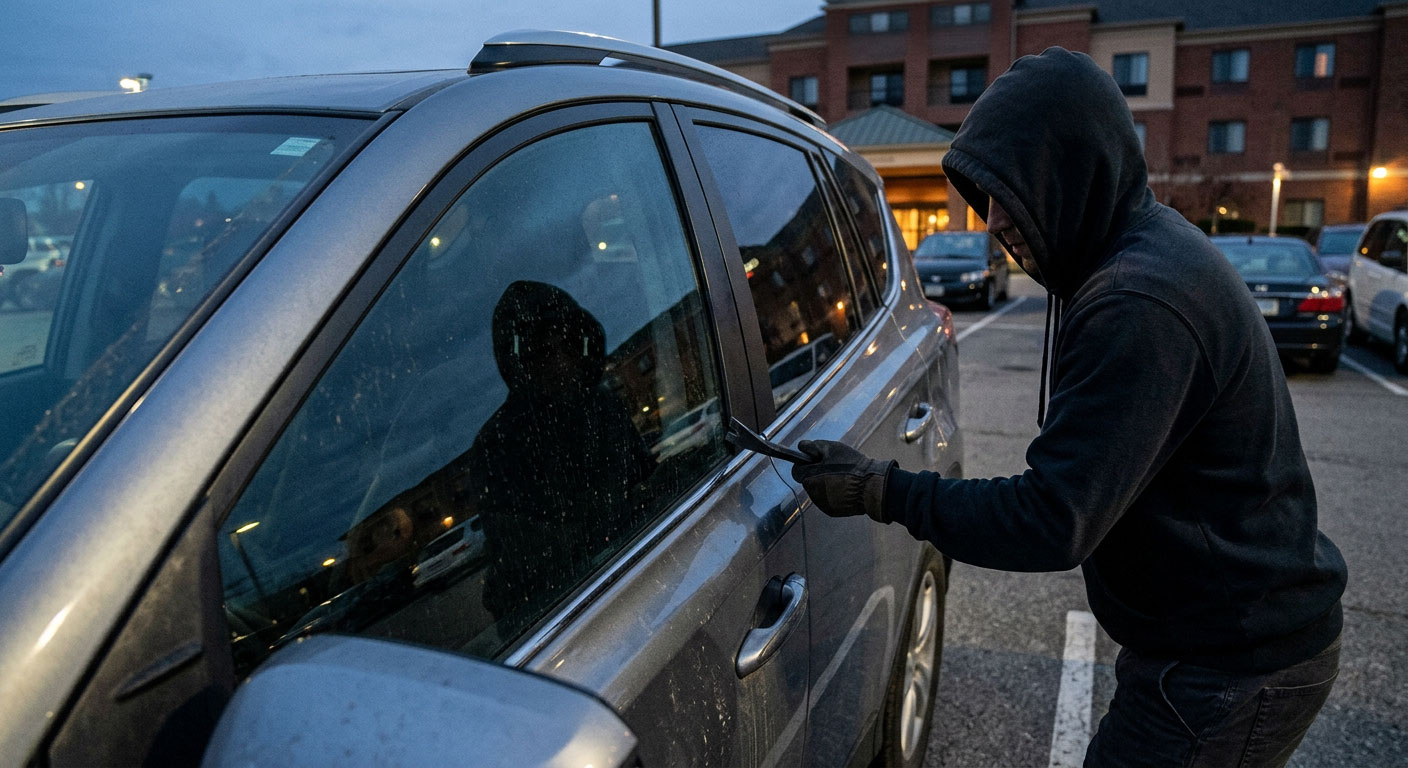
A smashed window and an empty console are one of the most common crimes in Central Ohio — and one of the most preventable. Theft from a parked vehicle rarely makes the evening news unless it happens 75 times in one night, but it happens constantly, in almost every kind of parking lot the region has: apartment communities, hotel lots, retail centers, park trailheads, gym lots, and residential driveways.
For drivers, it’s an expensive inconvenience. For the people who own and manage the property those cars are parked on, it’s something else: a tenant retention problem, a guest satisfaction problem, and a growing liability question.
What the numbers show
Columbus police reported a 5 to 10 percent increase in vehicle thefts during the first three months of 2025 compared with the same period in 2024, alongside what Sergeant James Fuqua described as “a rise in car break-ins particularly in large-scale places, like businesses.” The division stepped up patrols in the hardest-hit areas and later stood up a dedicated task force focused on chronic offenders.
The clearest window into the problem comes from the hospitality sector. Between June 2024 and February 2025, Columbus-area hotels documented 959 incidents of vehicle break-ins, theft, and vandalism in their parking lots. Some individual properties logged 30 to 60 incidents. Two logged more than 100 each. Those hotels also reported roughly $1.25 million in added annual security spending and about $1 million in lost revenue — plus nearly 300 negative guest reviews tied directly to parking lot crime.
Firearms are a major driver. Columbus police recorded 214 guns stolen from vehicles between January and July 2025 — 205 handguns, eight rifles, and one shotgun — down from 277 during the same stretch in 2024. The decline is real progress, but the underlying pattern is national: research from the Council on Criminal Justice found that 40 percent of all reported gun thefts came from vehicles by 2022, up from 31 percent in 2018, while gun thefts from parking lots and garages specifically rose 76 percent over that period.
One important caveat: these figures understate the problem. Many drivers never file a report when nothing of value was taken, and Columbus police have publicly asked residents to report every incident.
The trends behind the break-ins
It’s volume, not skill. Most break-ins are opportunistic. Crews move through a lot pulling door handles, and the cars that open are the cars that get hit. When a lot yields nothing easily, they escalate to breaking glass — which is why a single overnight sweep can leave dozens of vehicles damaged. In Grove City in August 2025, roughly 75 vehicles were hit in a single night. At an apartment community on the far west side, dozens of windows were smashed and almost nothing was taken.
Organized groups are working multiple properties. In May 2026, ten juveniles and one adult were charged in connection with a Columbus theft ring that operated from February to November 2025, taking vehicles, credit cards, firearms, and more than $500,000 in merchandise — with a Stelzer Road hotel among its regular targets. These groups don’t hit one lot; they run a circuit.
The target list is broad. Guns, work tools, laptops, credit cards, and anything that can be resold quickly. But the biggest lure is still an ordinary bag. As one Columbus commander noted, thieves can’t tell whether a backpack on the seat is worthless or a jackpot — so they break the window to find out.
Large, unmonitored lots take the brunt. Hotels, malls, restaurant rows, park-and-rides, trailheads, and apartment parking areas share the same profile: high vehicle counts, low natural surveillance, easy in-and-out access, and nobody who considers the lot their responsibility after dark.
How drivers reduce their risk
- Take it with you. Nothing visible — no bags, no chargers, no loose change, no gym duffel. An empty interior is the single most effective deterrent.
- Never leave a firearm in a vehicle. If it’s unavoidable, use a lock box secured to the vehicle frame, not the glovebox or console.
- Lock every time, every trip. A large share of break-ins involve no forced entry at all.
- Park in light and in view. Under a light pole, near an entrance, within camera coverage, and away from perimeter edges and back rows.
- Don’t stage valuables at your destination. Moving a laptop to the trunk in the parking lot is often watched.
- Report every incident, even one with no loss. Reports are what build the case files that shut down a crew.
What property managers can do to stop being the target
Thieves choose properties the same way they choose cars — by reading signals. These are the ones that matter most.
Fix the lighting first. It’s the cheapest, highest-return change available. Walk the property at 11 p.m., not at 2 p.m. Look for burned-out fixtures, dark back rows, shadowed corners behind dumpsters and stairwells, and overgrown landscaping blocking pole lights. Uniform, bright coverage across the entire lot — not just near the buildings — changes the calculation.
Control access, even loosely. Gates, one-way spike lanes, restricted entry points, and closed or staffed garage access remove the fast escape route that lot crews depend on. A property with one way in and one way out is materially harder to work.
Understand what cameras do and don’t do. Cameras document; they rarely deter. Their value is in solving the case afterward — which requires adequate coverage of entry points and drive lanes, functional night-quality video, current retention, and someone who knows how to pull the footage. Cameras alone are not a security plan.
Add unpredictable presence after dark. This is what actually breaks the pattern. Vehicle break-ins depend on knowing a lot is unwatched. Randomized marked patrols during peak hours — generally 10 p.m. to 4 a.m. — mean a crew can’t predict whether a unit will roll through in five minutes or fifty. For most multi-building communities and commercial lots, this is the difference-maker.
Communicate with residents and guests. Post signage, send seasonal reminders, and tell people what you’re doing. Tenants who see the property responding are far less likely to leave over an incident than tenants who hear nothing.
Document your response. Keep a record of incidents, complaints, and the steps you took after each one. Ohio premises liability turns heavily on what an owner knew and what they did about it. A documented pattern of reported problems with no corresponding action is the hardest position to defend. This isn’t legal advice — talk to your counsel and carrier about your specific exposure.
Track your own numbers. Most properties genuinely don’t know how many incidents they had last year. Ask your on-site team to log every reported break-in with date, time, and location on the property. Two months of that data will tell you exactly where and when your coverage gap is.
Get an honest read on your property
Break-ins concentrate where the opportunity is easiest. Lighting, access control, and visible, unpredictable patrol coverage move a property off the target list — usually for far less than the cost of the incidents, turnover, and reviews that follow a bad summer.
PSI’s Private Security and Investigations provides armed patrol officers and on-site security across Columbus and Central Ohio, with routes built around each property’s actual risk pattern. Learn more about our vehicle patrol services, or contact us for a free security assessment of your parking areas.